


It’s been a very long time since I posted again, but todat I wanted to give a little peek inside the woodshed.
In some of my previous posts, I talk about how we can study the fretboard:


It’s important to note that these are starting points. They’re fundamental exercise to do, in order to develop fluency and a sense of freedom on the fretboard.
They lay the groundwork for creativity; they’re meant to be built upon.
Here’s my attempt to show what that might look like.
Breakdown
I created a simple backing track using an E pedal played by a bass and a drum groove.
I also specifically used a tempo that’s not super comfortable (124bpm).
Then, it’s just a matter of recording yourself.
You may have heard this before, but recording yourself is incredibly effective and valuable.
It forces you to focus (you will become véry self-conscious), pay attention and it forces you to not play any gibberish.
These are the things I was focussed on while playing:
Staying rhythmically in the groove
Focus on expressiveness, articulation, dynamics
And these are some of the techniques I used to create lines:
Using chromatic passing tones
String skipping w/ 2NPS patten
Switching between modes (minor, mixolydian, lydian, major)
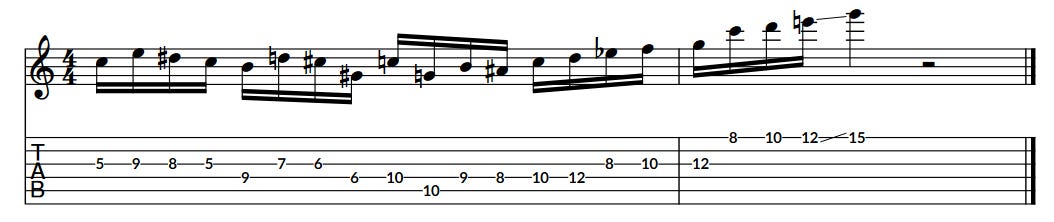
Applying a specific Holdsworth-inspired line I came up with*
*This is the Holdsworth-inspired line I mention above, which appears at 0’13” in the video:
I hope this gives a little insight into how the process works and how these “dry, boring” scale exercises apply to real-world practice.
Until next time!

